The house is harmless; it is simply standing where nothing should stand
You Should Have LeftThe house is harmless; it is simply standing where nothing should stand is the narrator’s concise explanation of the mountain house’s true danger. The phrase separates the ordinary structure from the impossible place in which it has been erected: the building is not attacking anyone, but its presence violates the conditions that should govern location, architecture, and reality.
Meaning and Immediate Context
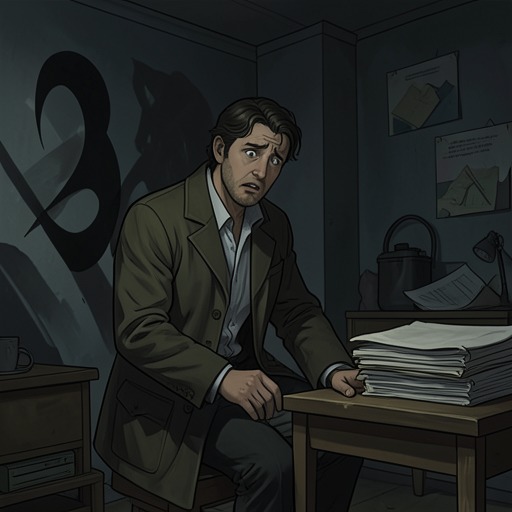
The expression appears after the narrator has carried Esther through a sequence of disturbing spatial and visual anomalies and locked the door to the living room. A man briefly seemed to stand on the ceiling, looking down as though asking for help. The narrator also saw an empty room containing a lightbulb and a broken chair open into another room of the same kind, followed by a third room in which something might have moved across the floor. Because the vision lasted only a moment and exhaustion had become severe, the narrator admits uncertainty about what was actually perceived. Against this instability, the expression offers a provisional distinction: the house itself is harmless, while the place is not.
The wording therefore functions less as a confident solution than as an act of intellectual triage. It assigns innocence to the visible object and danger to its setting. The house does not need a human motive, a supernatural will, or a conventional mechanism of attack. Its mere location is enough to produce consequences that ordinary language and ordinary geometry cannot contain.
The Place Rather Than the Building
The narrator begins the explanation by identifying the source as the place itself rather than the house. This distinction changes the story’s implied antagonist. A haunted house conventionally carries the threat within its walls; here, the walls may be no more responsible than the people trapped among them. The building has become an accidental marker or structure standing at a point where structures should not exist.
That formulation also preserves a troubling innocence. Calling the house harmless does not make the situation safe. It makes the danger more impersonal and more difficult to resist, because there is no creature to confront and no intention to negotiate with. The house’s apparent neutrality coexists with its catastrophic effect on perception and movement. Its wrongness is ontological: it occupies an impossible position before anyone decides what that position means.
Infinity and Thin Places
The expression expands into the narrator’s speculation that other places like this may exist. They could be unreachable on the sea bottom or in mountain caves untouched by human beings, or there might be only one such place nearby while the next lies light-years away in the infinite universe. The thought leads to a vision of an actual, non-fictional infinity filled with things, creatures, galaxies, galaxy clusters, and clusters of galaxy clusters, extending without end in either direction.
Within that imagined scale, the mountain house is not an isolated gothic curiosity but a point at which the substance of reality becomes thin. The narrator’s account of spatial irregularity is thus connected to a cosmological possibility: the world may contain discontinuities where incompatible spaces overlap. The repeated rooms are not merely deceptive appearances; they suggest a structure whose boundaries have lost their ordinary authority.
Limits of Language and Knowledge
The final qualification, that words do not capture how things really are, places the expression inside a larger crisis of representation. The narrator can name the house, the rooms, the ceiling, the door, and the lightbulb, but those familiar terms cannot adequately describe their arrangement once the place has become impossible. Language remains available while its organizing power fails.
The expression is consequently both explanatory and incomplete. It gives the reader a rule of interpretation—do not treat the house as a deliberate monster—but immediately exposes the inadequacy of rules when reality itself has become unstable. Its significance lies in that tension: a plain sentence tries to domesticate an experience of infinite, structureless possibility, yet the sentence ultimately points beyond what it can say.